The Core of Organic Chemistry
What's in this lesson: You will learn to identify and classify the four fundamental types of organic reactions: Substitution, Addition, Elimination, and Rearrangement.
Why this matters: Every biological process in your body and every synthetic material you use is the result of organic reactions. Recognizing these patterns allows you to predict how molecules will behave and transform.
In organic chemistry, billions of known reactions can be boiled down to just a few simple patterns. It is all about the breaking and making of bonds.
The 4 Reaction Archetypes
Organic molecules undergo structural changes through four primary mechanisms. Click each card to reveal its core definition.
Take a mental note of these four actions: Swap, Merge, Split, Shuffle.
Type 1: Substitution Reactions
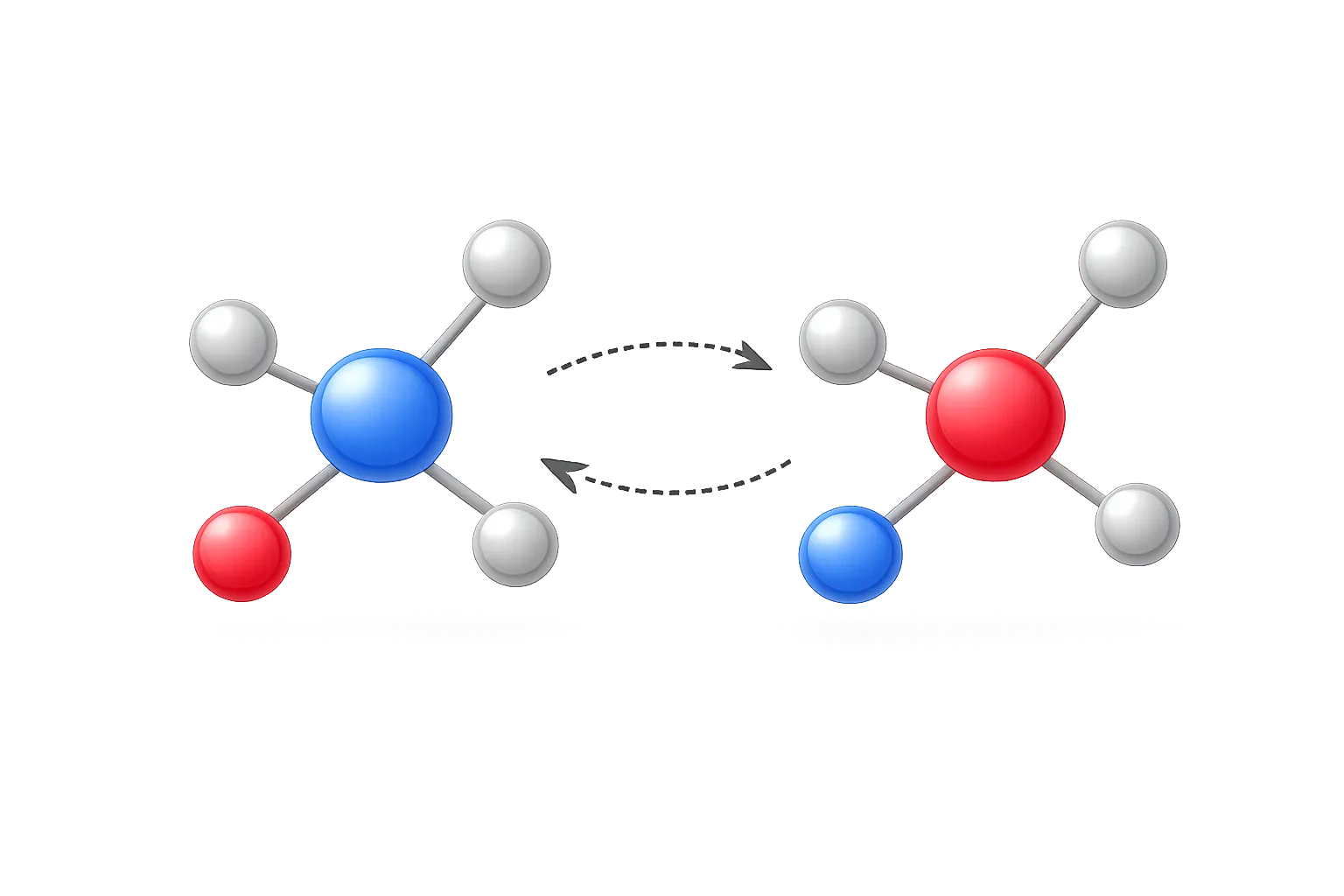
Definition: A reaction in which an attacking species (nucleophile, electrophile, or free radical) replaces another atom or group in the substrate.
In organic chemistry, this is typically represented as a substrate (R-X) reacting with an attacking group (Y).
Interactive: Click anywhere in this box to perform the substitution!
Success! The attacking group (Y) has replaced the leaving group (X).
Substitution in Action
Let's look at a real chemical example of a substitution reaction.
Reactants: Chloroethane + aqueous Potassium Hydroxide.
Products: Ethanol + Potassium Chloride.
Knowledge Check
In the reaction CH₃–Br + NaOH(aq) → CH₃–OH + NaBr, what describes the structural change?
Type 2: Addition Reactions
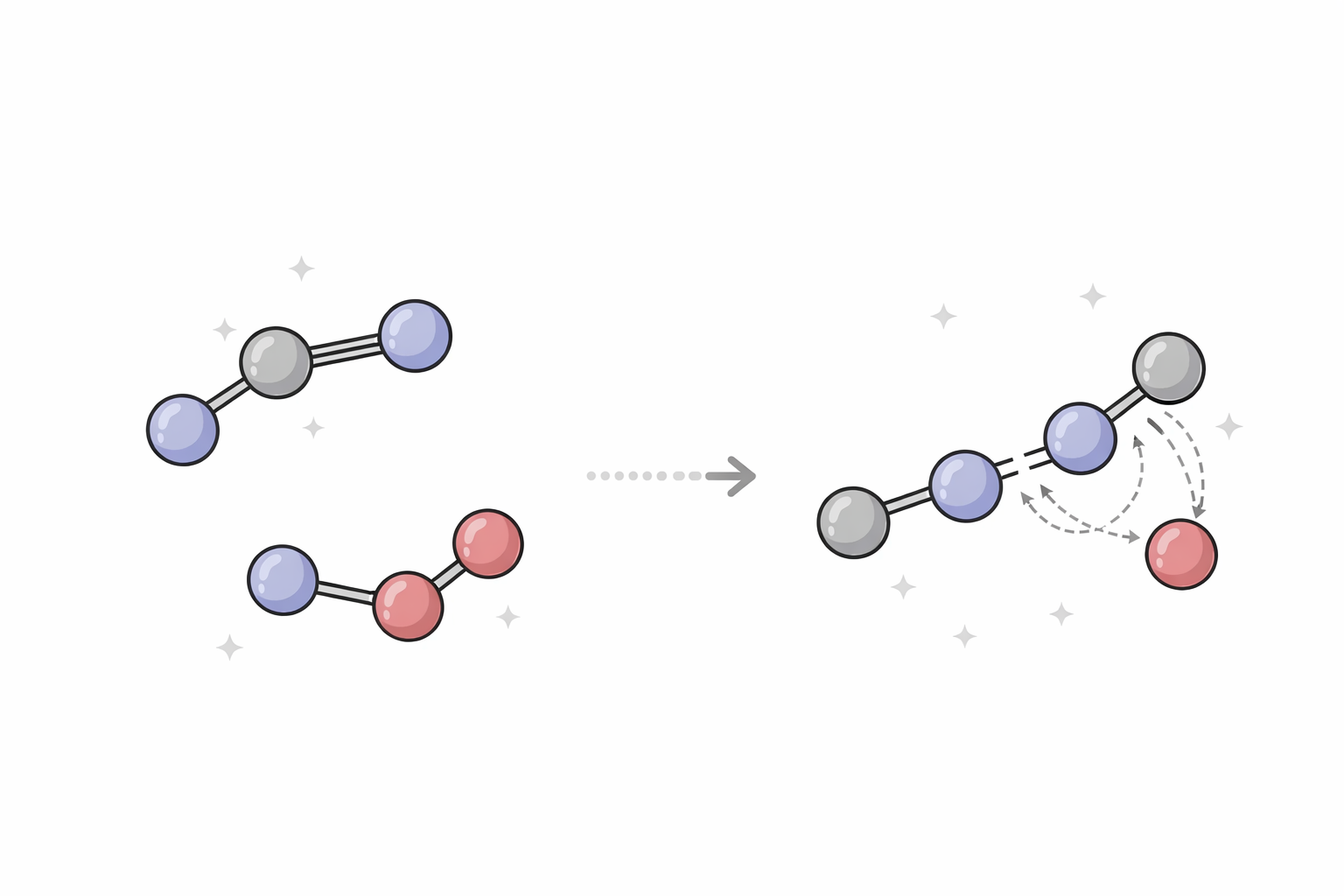
Definition: When two molecules combine to form only one product molecule.
This process typically requires the reactant to have a double or triple bond (pi bond). The pi bond breaks, allowing new atoms to attach to the carbon skeleton.
Interactive: Click to break the double bond and add molecules!
Addition in Action
Here is how an alkene reacts with a hydrogen halide.
Reactants
Ethene: Contains a carbon-carbon double bond.
HCl: Hydrogen chloride molecule.
Product
Chloroethane: The double bond is gone. H attached to one carbon, Cl to the other.
Notice how two distinct reactant molecules merged into a single product molecule. This is the hallmark of an addition reaction.
Knowledge Check
Which of the following visual cues is the strongest indicator of an addition reaction?
Type 3: Elimination Reactions
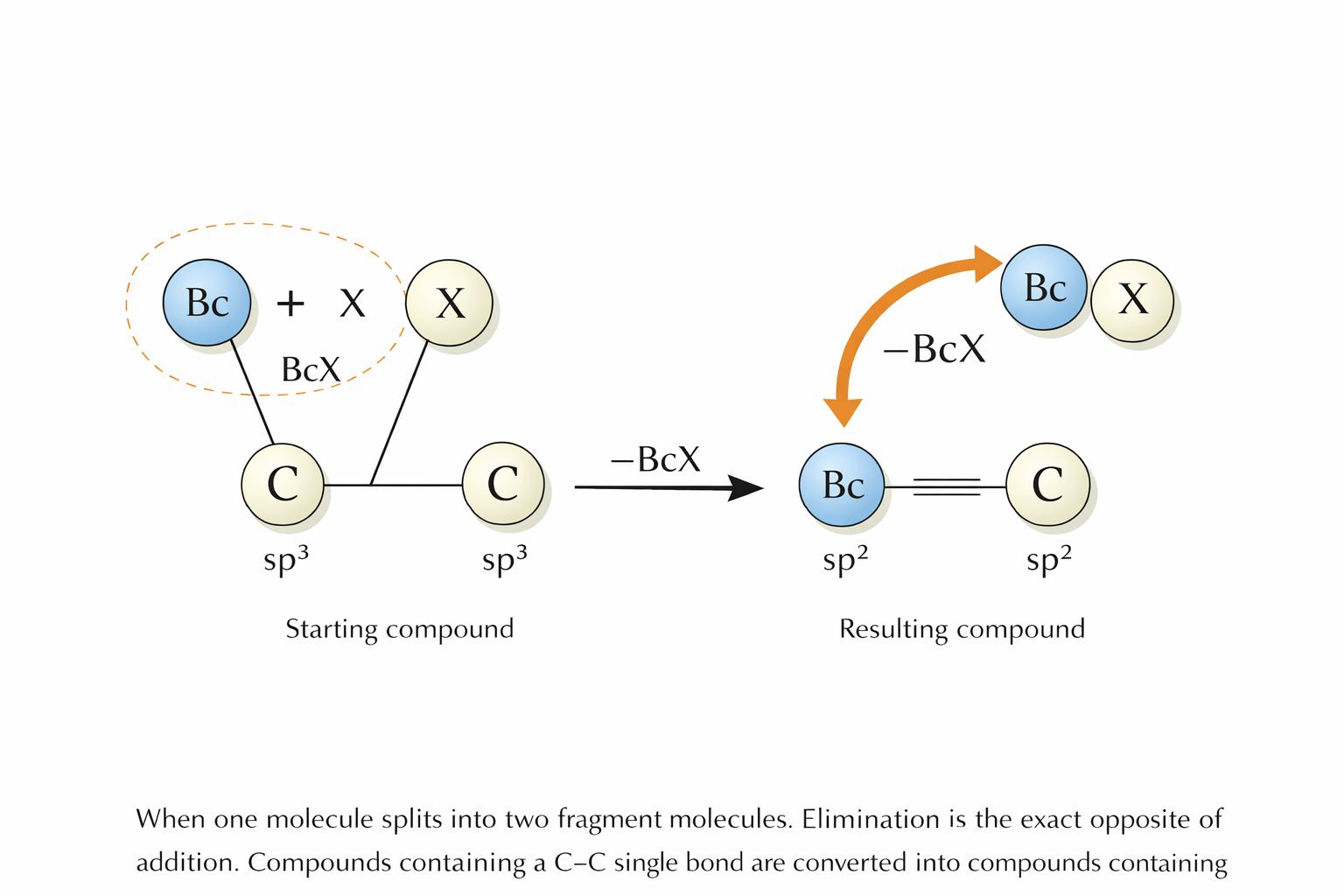
Definition: When one molecule splits into two fragment molecules.
Elimination is the exact opposite of addition. Compounds containing a C–C single bond are converted into compounds containing a C=C double bond by removing atoms or groups from adjacent carbon atoms.
Interactive: Click to remove atoms and form a double bond!
Elimination in Action
Let's look at the elimination of chloroethane. Note the specific reagent condition required.
In this reaction, H and Cl are eliminated from adjacent carbon atoms to form the double bond in Ethene.
Knowledge Check
You have a sample of Chloroethane and you want to produce Ethene (a molecule with a double bond). Which reagent should you use?
Type 4: Rearrangement Reactions
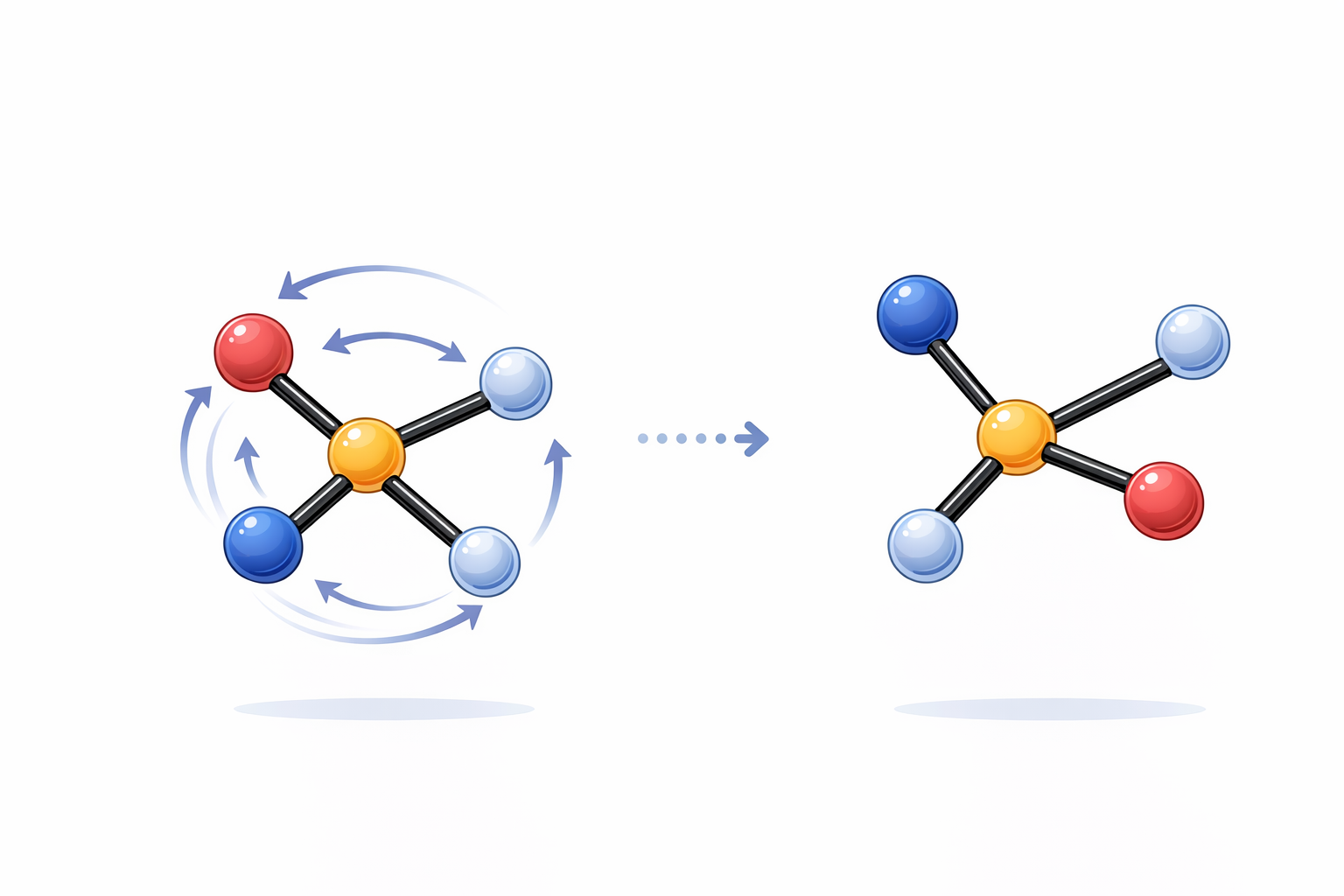
Definition: A reaction in which either the carbon skeleton, the functional group, or both are modified to form an isomer.
Nothing is added, and nothing is completely lost. The atoms simply "shuffle" into a new, often more stable, configuration.
Interactive: Click to shuffle the atoms!
Rearrangement in Action
A classic example is tautomerism, where a proton (H⁺) shifts its position within the molecule.
Ethenol (Vinyl Alcohol)
Formula: C₂H₄O
Has a double bond (C=C) and an alcohol group (-OH).
Ethanal (Acetaldehyde)
Formula: C₂H₄O
The double bond moved to the oxygen (C=O), and the H moved to the carbon. It is an aldehyde.
Notice the molecular formula (C₂H₄O) remained exactly the same! Only the connectivity changed.
Knowledge Check
Which feature distinguishes a rearrangement reaction from the other three types?
Summary of Reaction Types
Review the four types before moving on to the final assessment.
| Type | Core Action | Key Identifier |
|---|---|---|
| Substitution | Swap | A + BC → AC + B |
| Addition | Combine | A + B → C (double bond breaks) |
| Elimination | Split | C → A + B (double bond forms) |
| Rearrangement | Shuffle | A → B (A and B are isomers) |
Ready for the Assessment?
You will face 5 questions. You need 80% to pass.
Final Assessment
Test your knowledge on the types of organic chemistry reactions.
There are 5 questions. Select the best answer for each.
Question 1
Identify the type of reaction:
CH₃–Br + KOH(aq), Δ → CH₃–OH + KBr
Question 2
Identify the type of reaction:
CH₃–CH = CH₂ + Cl₂ → CH₃–CHCl–CH₂Cl
Question 3
Identify the type of reaction:
CH₃–C=N–OH → CH₃–CONH–C₆H₅ (with H₂SO₄)
Question 4
Identify the type of reaction:
CH₃–CH₂–OH → CH₂=CH₂ + H₂O (conc. H₂SO₄)
Question 5
Which reaction type typically converts a single bond to a double bond by removing atoms?